
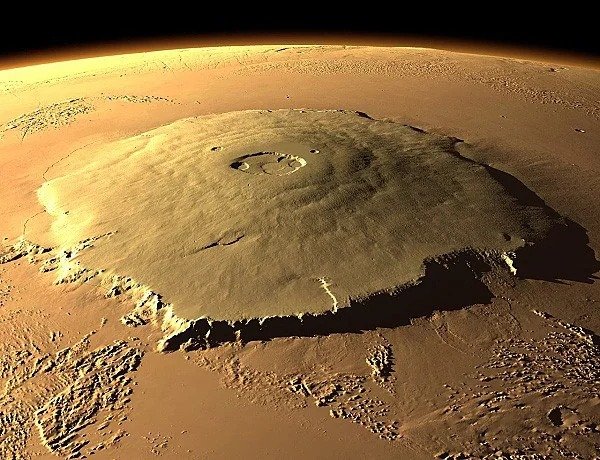

When people think of the tallest mountain, they usually picture Mount Everest. But the highest peak in our solar system isn’t on Earth, it’s on Mars.
Olympus Mons, a giant shield volcano on the Red Planet, rises about 16 miles (25 kilometers) above the surrounding plains, making it nearly three times taller than Mount Everest, which stands 5.5 miles (8.8 kilometers) above sea level.
Located in the Tharsis Montes volcanic region near Mars’ equator, Olympus Mons is the largest of a dozen enormous volcanoes. It stretches an astonishing 374 miles (600 kilometers) across, roughly the size of the U.S. state of Arizona or nearly as wide as France.
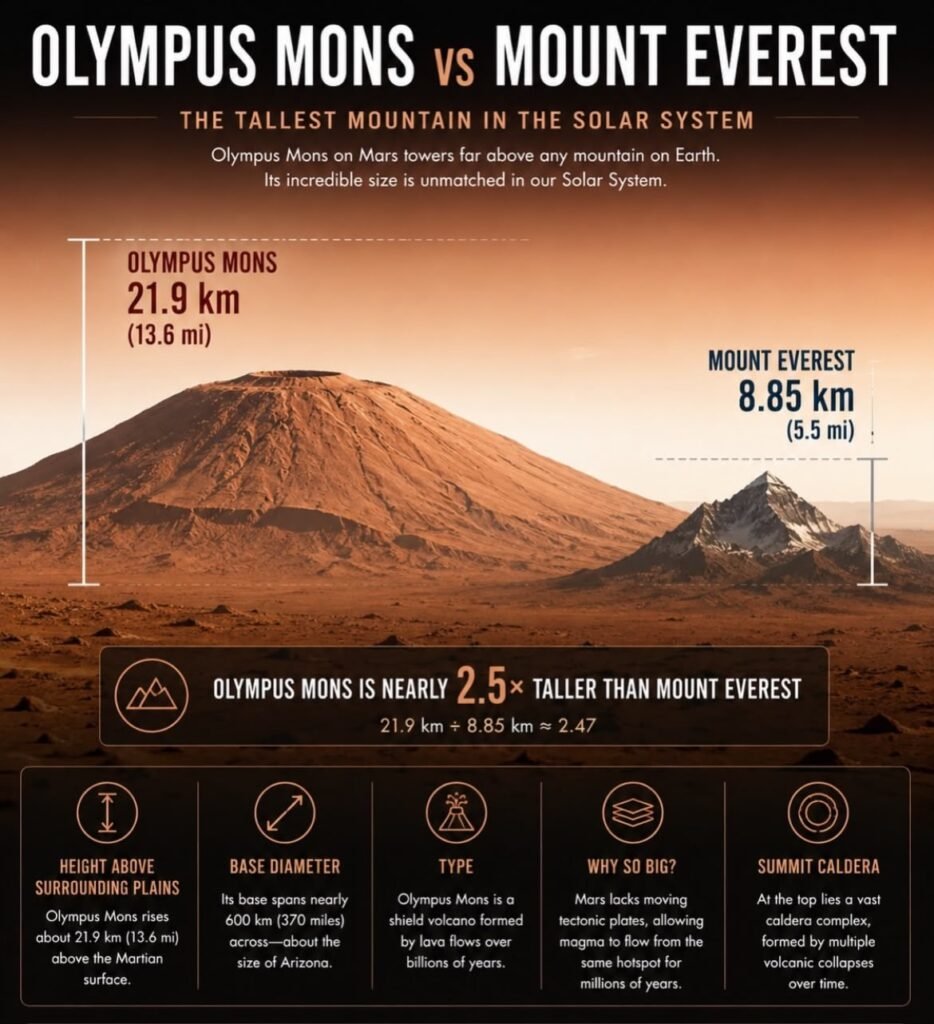
Unlike Earth’s volcanoes, Olympus Mons grew over billions of years as lava repeatedly erupted from the same volcanic hotspot. Because Mars does not have moving tectonic plates like Earth, the hotspot remained fixed, allowing layer upon layer of lava to accumulate and build the mountain to record-breaking heights.
Its immense size is difficult to comprehend. An astronaut standing on its slopes would not be able to see the volcano’s full profile because the curvature of Mars would hide much of it from view. At its summit lies a vast complex of collapsed volcanic craters, known as calderas, formed after repeated eruptions emptied underground magma chambers.
How Scientists Measure a Mountain on Mars
Measuring elevation on Mars is more complicated than on Earth because the planet has no oceans to provide a natural sea level. Instead, scientists use an imaginary reference surface called the areoid, which functions as the Martian equivalent of sea level.
Measured from the areoid, Olympus Mons stands about 13 miles (21 kilometers) high, still the tallest known mountain in the solar system by a wide margin.
How Does It Compare With Earth’s Highest Mountains?
The scale of Olympus Mons becomes even more remarkable when compared with Earth’s famous peaks.
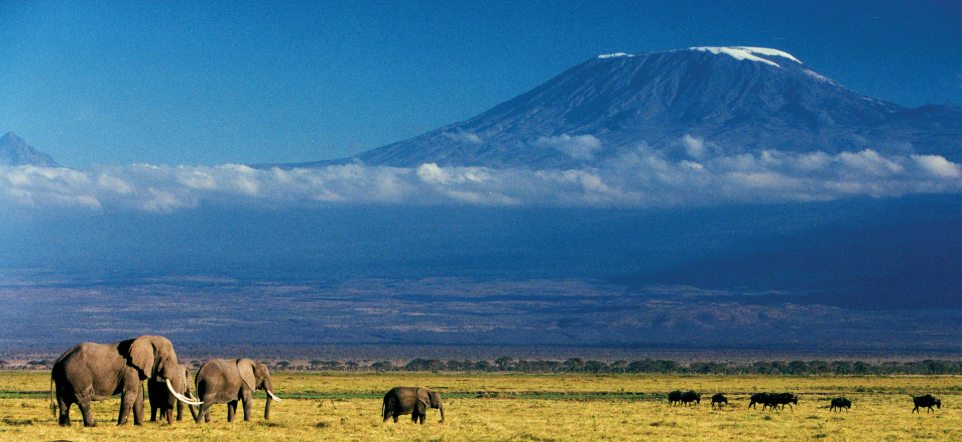
Climbers usually spend five to nine days reaching the summit of Mount Kilimanjaro, Africa’s highest mountain in Tanzania. Scaling Mount Everest, the world’s tallest mountain above sea level, typically takes six to eight weeks because climbers must gradually acclimatize to the thin air at extreme altitudes.
Olympus Mons, however, dwarfs both mountains in both height and width.
Could Olympus Mons Erupt Again?
Despite forming over billions of years, Olympus Mons is considered relatively young by planetary standards. Scientists believe that some lava flows on its surface may be only a few million years old, a relatively recent period in the history of the solar system.
That has led some researchers to suggest the volcano may not be completely extinct and could still have the potential for future volcanic activity.
“On Earth, the Hawaiian Islands were built from volcanoes that erupted as the Earth’s crust slid over a hot spot, a plume of rising magma,” said Jacob Bleacher, a planetary scientist at Arizona State University and NASA’s Goddard Space Flight Center. “Our research raises the possibility that the opposite happens on Mars; a plume might move beneath the stationary crust.”
Scientists also believe Mars’ lower gravity and historically higher lava eruption rates allowed molten rock to accumulate to far greater heights than would be possible on Earth.
Olympus Mons remains one of the most spectacular geological wonders ever discovered, offering scientists valuable clues about the volcanic history of Mars and the evolution of rocky planets across our solar system. It also serves as a reminder that, while Earth is home to extraordinary landscapes, some of the universe’s greatest natural wonders lie on worlds far beyond our own.